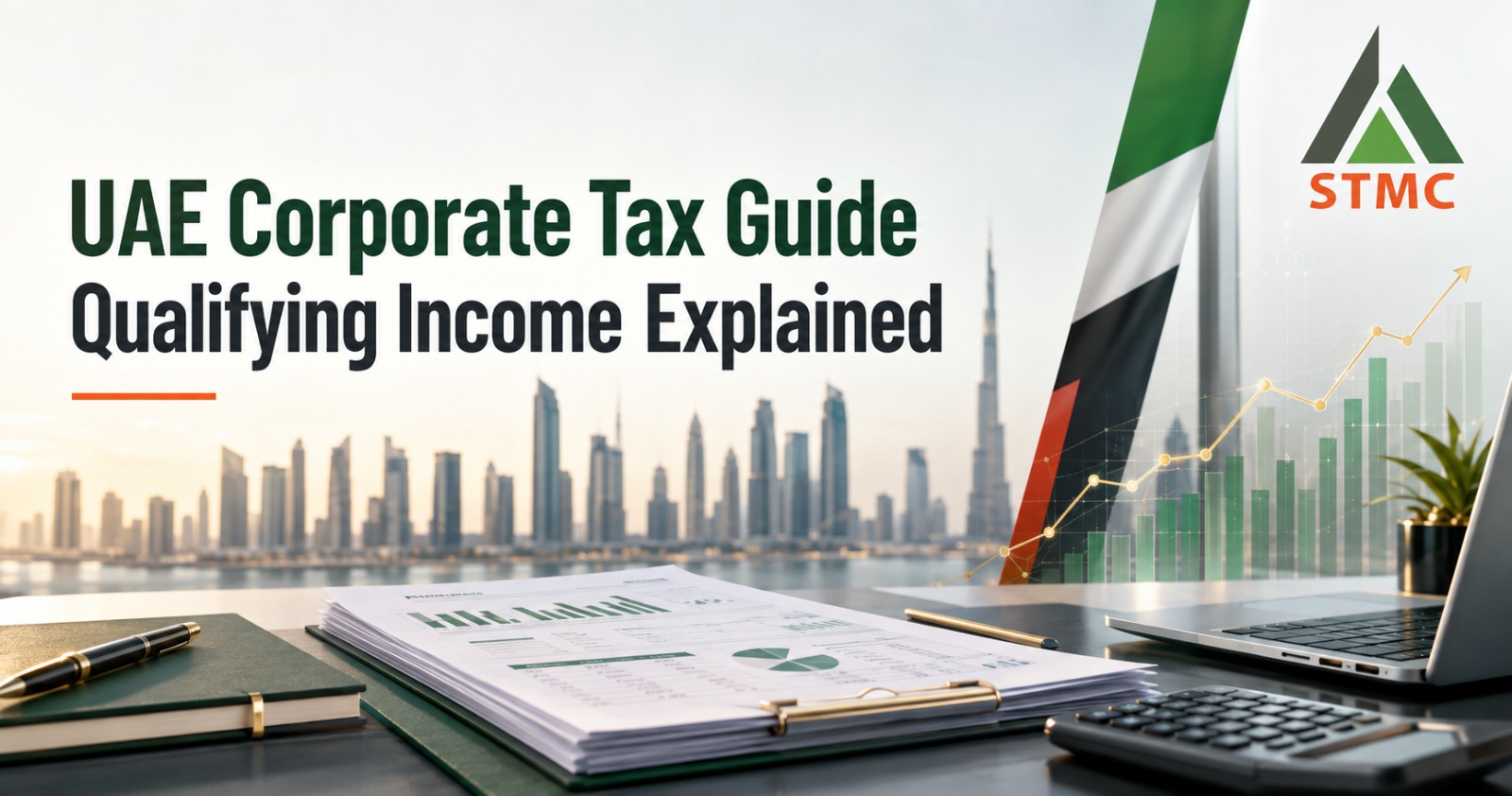
Qualifying Income is income that a Qualifying Free Zone Person (QFZP) earns from specified transactions or activities that meet the UAE Corporate Tax rules for the Free Zone regime. Qualifying Income can benefit from the 0% Corporate Tax rate, while taxable income that does not qualify is generally subject to the applicable 9% rate.
The introduction of UAE Corporate Tax has made the classification of business income more important than ever. This is particularly true for companies operating in UAE Free Zones.
Many businesses assume that simply being established in a Free Zone automatically means all their income will be taxed at 0%. However, that is not how the UAE Corporate Tax Free Zone regime works.
The 0% Corporate Tax rate applies specifically to Qualifying Income earned by a Qualifying Free Zone Person, provided the business satisfies the relevant conditions. Income that does not meet the qualifying requirements may be subject to the standard Corporate Tax rate.
Understanding what counts as Qualifying Income is therefore essential for Free Zone businesses planning their tax position, maintaining compliance and preparing accurate Corporate Tax returns.
If you are unsure how the rules apply to your business, experienced UAE Tax Consultants can help you assess your income, activities and Corporate Tax obligations.
Qualifying Income is income that falls within the categories specified under the UAE Corporate Tax rules for a Qualifying Free Zone Person.
Under Cabinet Decision No. 100 of 2023, Qualifying Income includes certain income earned from transactions with Free Zone Persons, certain transactions with Non-Free Zone Persons where the income relates to Qualifying Activities, income from Qualifying Intellectual Property and certain other income subject to the de minimis requirements.
In simple terms, the UAE Corporate Tax regime does not look only at where your company is registered. It also considers:
Who your customer is
What activity generated the income
Whether the activity is a Qualifying Activity
Whether the activity is an Excluded Activity
Whether the income relates to a permanent establishment
Whether the business satisfies the applicable conditions
Whether non-qualifying revenue remains within the permitted de minimis threshold
This makes income classification a key part of Free Zone Corporate Tax compliance.
The 0% rate is available to a Qualifying Free Zone Person (QFZP) on its Qualifying Income.
The Federal Tax Authority explains that a Free Zone entity meeting the relevant conditions can benefit from:
0% Corporate Tax on Qualifying Income
9% Corporate Tax on taxable income that does not meet the Qualifying Income definition
This distinction is extremely important.
A Free Zone company should not automatically calculate its entire profit at 0%. Instead, it needs to determine whether it qualifies as a QFZP and then identify which income meets the requirements for the 0% rate.
For businesses that need help understanding these classifications, professional Corporate Tax services from Sai Tax Management Consultants can provide support with Corporate Tax planning, compliance and reporting.
The UAE Corporate Tax framework identifies several categories of income that may qualify.
Income earned from transactions with another Free Zone Person can qualify, provided the income is not derived from an Excluded Activity and the relevant conditions are satisfied.
However, simply having a Free Zone customer does not mean every type of transaction automatically qualifies.
Businesses must assess the underlying activity and the nature of the transaction.
Income from a Non-Free Zone Person can also qualify in certain circumstances.
The income must generally relate to a Qualifying Activity and must not arise from an Excluded Activity.
This means a Free Zone business selling to mainland or overseas customers should not automatically assume that the revenue is subject to 9%.
The actual activity generating the income needs to be examined.
Certain income generated from the ownership or exploitation of Qualifying Intellectual Property can fall within Qualifying Income.
However, specific rules apply to determine how qualifying income from intellectual property is calculated.
Businesses involved in patents, software-related intellectual property or research and development should therefore maintain appropriate records supporting their qualifying expenditure and intellectual property activities.
Certain other income may qualify where the business satisfies the applicable de minimis requirements.
This is designed to allow a limited amount of non-qualifying revenue without automatically preventing a business from meeting the conditions for the Free Zone regime.
However, businesses need to calculate this threshold carefully rather than treating it as a general exemption.
The de minimis rule is particularly important for businesses with mixed sources of revenue.
Under the applicable rules, the non-qualifying revenue of a QFZP must not exceed the lower of:
5% of total revenue OR AED 5 million.
For example, suppose a Free Zone business has total revenue of AED 20 million.
Five percent of AED 20 million is AED 1 million.
Because AED 1 million is lower than AED 5 million, the relevant threshold would be AED 1 million.
If non-qualifying revenue exceeds the applicable threshold, the business may lose its ability to benefit from the QFZP regime, subject to the applicable legislation and conditions.
This is one reason businesses should monitor their revenue classification throughout the financial year rather than waiting until Corporate Tax return preparation.
The Ministry of Finance has also explained that failing to satisfy the de minimis requirements or other qualifying conditions can result in the Free Zone Person losing access to the Free Zone Corporate Tax regime for the applicable period under the rules.
Excluded Activities are activities that generally do not generate Qualifying Income for the Free Zone Corporate Tax regime, subject to specific exceptions and conditions.
Examples can include certain:
Transactions with natural persons
Regulated financial services
Transactions involving immovable property
Certain activities involving intellectual property
Other activities specified under the applicable UAE Corporate Tax rules
The exact treatment depends on the nature of the activity and the applicable legislation.
The UAE Ministry of Finance has published guidance explaining how Qualifying and Excluded Activities work within the Free Zone Corporate Tax regime.
Importantly, the rules have been updated over time. In 2025, the Ministry of Finance announced Ministerial Decision No. 229 of 2025, replacing the earlier Ministerial Decision No. 265 of 2023 and clarifying the scope of Qualifying and Excluded Activities.
Businesses should therefore check the latest legislation instead of relying on older summaries.
No.
This is one of the biggest misconceptions surrounding UAE Corporate Tax.
A company being incorporated or licensed in a UAE Free Zone does not automatically mean that all of its income receives the 0% rate.
The business must satisfy the conditions to be a QFZP and the relevant income must meet the requirements for Qualifying Income.
The FTA has specifically highlighted that Free Zone Persons must register for Corporate Tax regardless of whether they qualify for the 0% Free Zone regime.
Therefore, businesses should distinguish between:
Free Zone Person → A business established in a Free Zone.
Qualifying Free Zone Person → A Free Zone Person that satisfies the conditions required to access the Free Zone Corporate Tax regime.
Qualifying Income → Income that meets the requirements for the 0% Corporate Tax rate.
These three terms should not be used interchangeably.
A practical approach is to analyse each major revenue stream.
Determine exactly where the revenue comes from.
For example:
Product sales
Consultancy services
Management services
Trading
Investment income
Intellectual property
Financing activities
Property-related income
Determine whether the customer is:
A Free Zone Person
A Non-Free Zone Person
A natural person
Another category covered by the legislation
Determine whether the underlying activity is a Qualifying Activity or an Excluded Activity.
Income attributable to a Domestic or Foreign Permanent Establishment can have different Corporate Tax treatment.
The relevant provisions should therefore be considered when analysing income.
Where applicable, calculate non-qualifying revenue against the permitted threshold.
Keep contracts, invoices, accounting records, customer information and other relevant documents that support the classification.
This documentation can be important when preparing the Corporate Tax return or responding to an FTA enquiry.
Incorrect classification can result in incorrect Corporate Tax calculations.
For example, a business may assume that all its Free Zone revenue qualifies for 0% Corporate Tax when some revenue actually arises from an Excluded Activity.
This could create:
Incorrect tax calculations
Compliance risks
Potential penalties
Additional tax liabilities
Difficulty during an FTA review
Poor financial planning
Professional tax advice can help businesses identify these issues before the Corporate Tax return is filed.
Businesses can also read What UAE Tax Consultants Do and Why Businesses Need Them to understand how tax professionals can support businesses with Corporate Tax, VAT and broader compliance requirements.
Determining Qualifying Income can become complicated when a company has multiple activities, customer types or revenue streams.
Experienced UAE Tax Consultants can help businesses:
Review their Free Zone status
Analyse revenue sources
Identify Qualifying Activities
Identify Excluded Activities
Review customer classifications
Calculate the de minimis threshold
Assess Corporate Tax implications
Review accounting records
Prepare Corporate Tax returns
Maintain appropriate documentation
Monitor regulatory changes
Sai Tax Management Consultants provides Corporate Tax, VAT, audit and tax advisory services to businesses operating across the UAE. Its services include Corporate Tax registration, planning, filing and compliance support.
For businesses looking for broader guidance, the Corporate Tax Consultants Dubai guide provides additional information about Corporate Tax compliance and professional tax support.
Qualifying Income is income earned by a Qualifying Free Zone Person that meets the conditions specified under UAE Corporate Tax rules for the 0% Free Zone Corporate Tax rate.
No. Only income that meets the requirements for Qualifying Income can benefit from the 0% rate. Income that does not qualify may be subject to the standard 9% Corporate Tax rate.
The non-qualifying revenue must generally not exceed the lower of 5% of total revenue or AED 5 million, subject to the applicable rules and exclusions.
Yes. Free Zone Persons are required to register for UAE Corporate Tax even if they may qualify for the 0% rate on Qualifying Income.
Yes. UAE Tax Consultants can review a company's activities, customers, revenue streams and supporting records to help determine the appropriate Corporate Tax treatment and compliance requirements.
Qualifying Income is one of the most important concepts for UAE Free Zone businesses under the Corporate Tax regime.
The 0% Corporate Tax rate is not an automatic benefit simply because a company operates in a Free Zone. Businesses need to satisfy the conditions for Qualifying Free Zone Person status and ensure that their income meets the applicable requirements.
With the UAE Corporate Tax framework continuing to evolve, businesses should regularly review their activities, revenue classifications and documentation.
Working with experienced UAE Tax Consultants can help businesses understand the rules, identify potential risks and maintain a more structured approach to Corporate Tax compliance.
Sai Tax Management Consultants helps businesses across the UAE understand and manage Corporate Tax requirements with practical, professional guidance.
Whether you operate from a Free Zone or mainland UAE, our team can assist with Corporate Tax registration, tax planning, income assessment, compliance, filing and advisory services.
Don't leave your Qualifying Income classification to assumptions. Get your business reviewed by professionals and make informed Corporate Tax decisions.
Speak with the Sai Tax Management Consultants team to understand how UAE Corporate Tax rules apply to your business and revenue streams.
Book an Appointment today and take the next step toward confident, compliant UAE tax management.
For the latest requirements, businesses should consult the Federal Tax Authority's Corporate Tax legislation and the official FTA guidance on Free Zone Persons.
Disclaimer: UAE Corporate Tax legislation, Cabinet Decisions, Ministerial Decisions and FTA guidance may be amended from time to time. This article is for general informational purposes and should not be treated as legal or tax advice. Businesses should review the latest official guidance or obtain professional advice before making tax decisions.