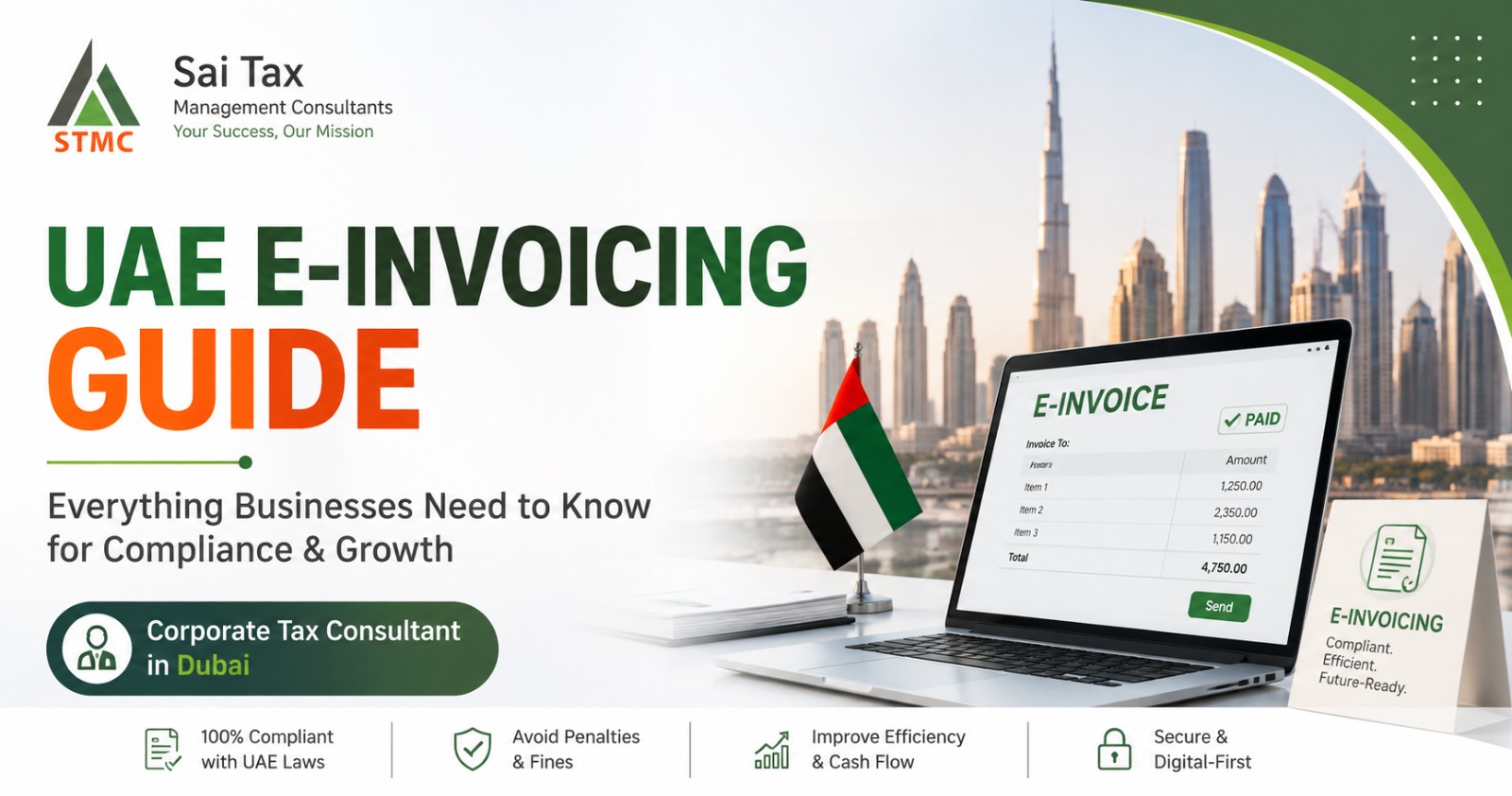
UAE e-invoicing is being introduced through a phased rollout. The pilot and voluntary phase started on 1 July 2026, while mandatory implementation is scheduled from 1 January 2027 for businesses with annual revenues exceeding AED 50 million and from 1 July 2027 for businesses with annual revenues below AED 50 million. Businesses should begin preparing their systems, data, processes and Accredited Service Provider (ASP) arrangements well before their applicable deadline.
The UAE is rapidly moving toward a more digital, transparent and technology-driven tax environment. One of the most significant changes businesses need to prepare for is electronic invoicing or e-invoicing.
For UAE businesses, e-invoicing is more than replacing paper invoices with PDFs. The new system is designed around structured electronic invoice data and digital exchange through an approved framework.
This means businesses need to review their accounting systems, invoice workflows, financial data and compliance processes before the mandatory implementation dates arrive.
At the same time, e-invoicing should not be considered separately from VAT, Corporate Tax and general financial compliance. Businesses can benefit from coordinating these requirements as part of one broader compliance strategy.
If you need professional assistance with UAE tax compliance, working with a Corporate Tax Consultant in Dubai can help you understand your obligations and prepare your financial processes more effectively.
UAE e-invoicing is a structured electronic invoicing system that enables businesses to create, exchange and process invoice information digitally.
It is based on the OpenPeppol framework and is intended to improve the efficiency, transparency and reliability of invoice exchanges between businesses and other relevant parties.
The important point for businesses is that an e-invoice is not simply a digital copy of a traditional invoice.
A PDF invoice sent by email may look digital, but it does not necessarily meet the definition of a structured e-invoice under the UAE framework.
The UAE Ministry of Finance provides official guidance and updates through its UAE eInvoicing portal. Businesses should use the Ministry's latest guidance when making implementation and compliance decisions.
No. A PDF, scanned document or ordinary email invoice is not the same as a compliant structured e-invoice.
This distinction is particularly important for businesses that already use accounting software to generate PDF invoices.
Under the UAE framework, e-invoices are structured electronic documents that can be automatically processed and exchanged through the required electronic invoicing infrastructure.
Therefore, simply changing from printed invoices to PDF invoices will not necessarily make a business ready for UAE e-invoicing.
Businesses should assess whether their existing accounting or ERP platform can support the required structured data and integration processes.
The UAE has adopted a phased implementation approach.
The voluntary implementation phase began on 1 July 2026. Mandatory implementation will then apply to different categories of businesses according to the applicable thresholds and dates.
The Ministry of Finance announced in May 2026 that the deadline for businesses with annual revenues exceeding AED 50 million to appoint an Accredited Service Provider was extended from 31 July 2026 to 30 October 2026. The mandatory implementation date of 1 January 2027 remains unchanged.
Businesses should therefore avoid assuming that the ASP deadline extension means the overall implementation deadline has also been postponed.
Businesses operating in the UAE should assess how the e-invoicing requirements apply to their activities, revenue and transaction types.
The implementation is particularly relevant to:
Large UAE businesses
Small and medium-sized enterprises
Businesses involved in B2B transactions
Businesses supplying government entities
Companies using ERP or accounting systems
Businesses with high invoice volumes
Companies with multiple branches or business units
Businesses looking to automate finance and tax processes
The exact scope, exclusions and requirements should be checked against the latest UAE Ministry of Finance regulations and guidance.
Because the framework is evolving, businesses should avoid relying solely on older articles or informal summaries.
An Accredited Service Provider (ASP) plays an important role in the UAE e-invoicing ecosystem.
An ASP provides the technology and services required to facilitate compliant electronic invoicing and the exchange of structured invoice information.
The Ministry of Finance maintains a list of accredited service providers and updates it as new providers complete the accreditation process. Businesses can review the current official list of UAE eInvoicing Accredited Service Providers before selecting a provider.
When evaluating an ASP, businesses should consider:
ERP and accounting software compatibility
Integration capabilities
Data security
Scalability
Transaction volume
Technical support
Implementation timelines
Data exchange capabilities
Compliance requirements
Cost and long-term value
Choosing an ASP should therefore be treated as a strategic business decision rather than simply selecting another invoicing software subscription.
E-invoicing implementation depends heavily on the quality and consistency of financial data.
Businesses should review their current invoice and accounting records and ensure that important information is correctly maintained.
Depending on the transaction and invoice type, businesses may need to manage information relating to:
Invoice identification
Invoice date
Supplier details
Customer details
Tax registration information
Currency
Product or service details
Tax information
Transaction values
Credit notes
Supporting accounting information
The UAE Ministry of Finance has published detailed UAE Electronic Invoicing Guidelines that businesses can use when reviewing their systems and processes.
Preparing early can reduce implementation pressure and help businesses identify problems before mandatory compliance begins.
Start by documenting how invoices are currently created, approved, issued, received and recorded.
Identify manual processes that could create delays or errors.
Determine which e-invoicing implementation phase applies to your business.
Revenue, business structure and applicable regulatory requirements should be reviewed carefully.
Check whether your existing accounting software or ERP system can support structured e-invoicing.
Some businesses may need software upgrades, API integrations or changes to their existing invoice-generation processes.
Review the current Ministry of Finance ASP list and shortlist providers that can integrate with your technology environment.
The Ministry's official accreditation process requires service providers to satisfy business and technical requirements before receiving accreditation.
Incorrect customer information, outdated tax details and inconsistent product or service records can create problems during implementation.
Before integrating systems, businesses should clean and standardize their financial data.
Testing should cover the complete invoice lifecycle.
Businesses should test:
Invoice creation
Invoice transmission
Invoice receipt
Validation
Error handling
Credit notes
Accounting entries
Data storage
Reporting workflows
Your e-invoicing system is only as effective as the people using it.
Finance, accounting, IT, sales and management teams should understand how the new process affects their responsibilities.
E-invoicing is closely connected to the broader financial records of a business.
Invoices provide important information about revenue, expenses, transactions and supporting documentation. Accurate and structured financial information can therefore contribute to better tax reporting and accounting controls.
Businesses should consider e-invoicing alongside:
UAE Corporate Tax
VAT compliance
Financial accounting
Tax reporting
Record keeping
Internal financial controls
If your business is reviewing its wider tax obligations, Sai Tax's Corporate Tax services can help with Corporate Tax registration, assessment, filing, reporting and ongoing compliance support.
This integrated approach can help businesses avoid treating every regulatory requirement as a separate project.
E-invoicing is primarily a digital and financial process, but it has important implications for tax compliance.
A professional Corporate Tax Consultant in Dubai can help businesses understand how their financial records, tax obligations and reporting processes work together.
Professional guidance can be particularly useful for businesses that:
Are newly established in the UAE
Have multiple revenue streams
Operate across different Emirates
Have complex accounting structures
Are preparing for Corporate Tax filing
Need support with VAT and tax compliance
Are implementing new accounting systems
Want to reduce compliance risks
Sai Tax Management Consultants provides tax and financial consultancy services to UAE businesses, including Corporate Tax planning, compliance, filing and advisory support.
For businesses looking for broader guidance, the complete Corporate Tax Consultants Dubai guide can also help explain how professional tax support can benefit UAE businesses.
Although regulatory compliance is a major driver behind e-invoicing, businesses can also gain operational benefits.
Structured data can reduce manual data entry and help minimize invoice-related errors.
Digital invoice exchange can reduce the time required to issue, receive and process invoices.
Finance teams can gain better visibility into invoice status and transaction data.
Digital processes can make it easier to organize and retrieve financial records.
E-invoicing can connect with accounting, ERP, procurement and payment processes, reducing repetitive manual work.
Standardized financial data can help businesses establish more consistent tax and accounting controls.
The UAE Ministry of Finance has positioned e-invoicing as part of the country's wider digital transformation and efforts to improve efficiency and transparency.
Businesses should avoid treating e-invoicing as a last-minute technology upgrade.
Common mistakes include:
System changes and integrations can take time. Starting early gives businesses more opportunity to test and resolve issues.
A PDF invoice should not automatically be considered a compliant e-invoice.
The cheapest solution may not necessarily be the most suitable solution for your accounting or ERP environment.
Incorrect customer, supplier or tax information can affect invoice processing.
Businesses should test invoice creation, transmission, validation, accounting and record retention.
Finance teams need to understand the new workflow before mandatory implementation.
E-invoicing should be coordinated with VAT, Corporate Tax, accounting and financial reporting requirements.
Businesses can use this checklist to assess their readiness:
Identify the applicable e-invoicing implementation date
Review current invoice-generation processes
Audit accounting and ERP systems
Review customer and supplier master data
Check tax and registration information
Identify required technology upgrades
Evaluate an Accredited Service Provider
Verify the ASP through the Ministry of Finance
Plan system integration
Test invoice transmission and receipt
Review credit note processes
Train finance and accounting teams
Establish appropriate data retention procedures
Review internal financial controls
Coordinate e-invoicing with VAT and Corporate Tax compliance
Monitor Ministry of Finance updates
Yes. UAE e-invoicing is being implemented in phases. Businesses with annual revenue exceeding AED 50 million are scheduled for mandatory implementation from 1 January 2027, while businesses below AED 50 million are scheduled for mandatory implementation from 1 July 2027.
No. A PDF, scanned invoice or ordinary email attachment is not the same as a structured electronic invoice under the UAE e-invoicing framework.
Businesses with annual revenue exceeding AED 50 million have an ASP appointment deadline of 30 October 2026. Businesses below AED 50 million have a scheduled ASP appointment deadline of 31 March 2027.
Yes. Businesses below AED 50 million are scheduled for mandatory e-invoicing implementation from 1 July 2027. Preparing in advance can give smaller businesses sufficient time to review their software, data and processes.
A Corporate Tax Consultant in Dubai can help businesses coordinate e-invoicing preparation with Corporate Tax, VAT, accounting and financial compliance requirements. They can also help identify documentation and record-keeping gaps that may affect tax compliance.
UAE e-invoicing represents an important change in how businesses manage invoices, financial data and compliance.
With mandatory implementation beginning in 2027, businesses should not wait until the final deadline to start preparing. Reviewing accounting systems, cleaning financial data, selecting an appropriate Accredited Service Provider and testing workflows can make the transition considerably smoother.
More importantly, e-invoicing should be integrated with the wider financial and tax strategy of your business.
Whether you are a startup, SME, free zone company or established enterprise, getting professional advice early can help you approach UAE tax compliance with greater confidence.
Sai Tax Management Consultants helps UAE businesses navigate tax, accounting and financial compliance requirements with practical professional guidance.
If your business needs support with Corporate Tax, VAT, financial compliance or preparing for the UAE's changing e-invoicing environment, speak with the experienced team at Sai Tax Management Consultants.
Don't wait until the compliance deadline. Plan ahead, strengthen your financial processes and prepare your business for the UAE's digital tax future.
Get professional guidance tailored to your business requirements and take the next step toward stronger UAE tax and financial compliance.
Book your appointment with Sai Tax Management Consultants today.
Useful Official Resources:
For the latest regulatory information, businesses should refer to the UAE Ministry of Finance eInvoicing portal, the official list of Accredited Service Providers and the Ministry's UAE Electronic Invoicing Guidelines.
Disclaimer: UAE e-invoicing regulations, implementation dates and technical requirements may be updated by the Ministry of Finance or other UAE authorities. Businesses should verify the latest official guidance before making compliance decisions.