
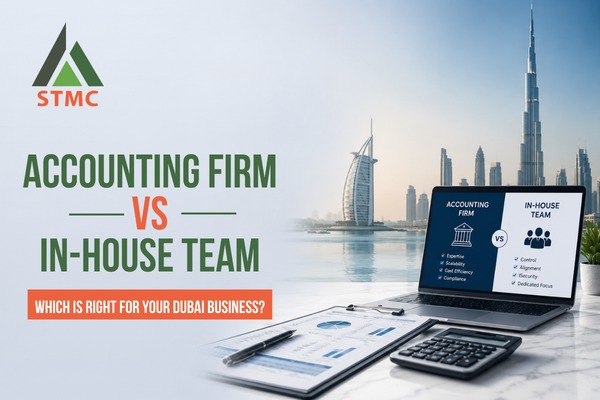
Quick answer: An outsourced accounting firm is usually the better fit for Dubai startups and SMEs that need broad expertise, flexible capacity and predictable support without the fixed cost of a full finance department. An in-house team is often better for larger or transaction-heavy businesses that require daily, embedded control. Many growing companies get the strongest result from a hybrid model: internal ownership of finance decisions supported by external specialists for accounting, tax, compliance and assurance.
Choosing the right finance model is not simply a hiring decision. It affects the quality of your records, the speed of management reporting, cash-flow visibility and your ability to respond to UAE tax and regulatory requirements. For a Dubai business, the right answer depends on complexity, transaction volume, internal controls, growth plans and the level of specialist knowledge required.
If you are comparing the Top Accounting Firms in Dubai, focus on the scope, review process and decision support you will receive not only the monthly fee.
Accounting firm vs in-house team at a glance
What does an outsourced accounting firm do for a Dubai business
An outsourced accounting firm provides agreed finance services without becoming part of your payroll. The engagement may cover routine bookkeeping, bank reconciliation, accounts receivable and payable, month-end closing, management reports, VAT support, Corporate Tax coordination, accounting-system setup and audit preparation. The exact scope should be written into the engagement letter, with deadlines, responsibilities, access controls and escalation points.
The UAE Federal Tax Authority publishes the official tax legislation, guides and decisions that businesses should use as the primary reference for current obligations. A capable provider should translate those requirements into practical accounting processes while making clear that tax treatment depends on the facts of each business.
What does an in-house accounting team offer
An in-house accountant or finance team works inside the business and can be closely integrated with sales, purchasing, operations and leadership. That proximity can improve response times and give management direct oversight of day-to-day financial workflows. However, one hire rarely covers every discipline. A bookkeeper, management accountant, tax adviser, controller and CFO perform different roles, so a growing company may need several people or outside support even after building an internal team.
When an accounting firm is likely to be the better choice
You are launching or scaling and need professional accounting without building a full department.
Transaction volume is manageable, but the business needs reliable monthly books and reporting.
You require access to accounting, VAT, Corporate Tax and compliance knowledge at different times.
Your current records are delayed, inconsistent or dependent on one employee.
You need flexible capacity for year-end work, tax deadlines, an audit or a system migration.
Management wants a defined service scope and a more predictable operating cost.
Outsourcing works best when the provider understands your sector, assigns clear points of contact and documents its review controls. Ask who prepares the work, who reviews it, how exceptions are reported and how quickly questions are answered.
When an in-house team is likely to be the better choice
Your business has high daily transaction volume or complex operational workflows.
Finance must collaborate continuously with inventory, procurement, projects or multiple business units.
Leadership needs rapid, customised analysis throughout the day.
The company has enough recurring work to justify specialist finance roles.
Direct control over data access, approvals and process changes is a central operating requirement.
You can recruit, train and retain the right people and provide adequate segregation of duties.
An internal team still needs documented procedures, appropriate review and backup coverage. Hiring one person without a control framework can create a single point of failure rather than a complete finance function.
The hybrid model is often the practical middle ground
A hybrid model keeps operational ownership inside the company while using an external firm for specialist or review work. For example, an internal finance executive may manage invoicing, collections and document flow, while an accounting firm handles month-end review, management reporting, VAT support, Corporate Tax coordination and audit readiness.
This approach can give management faster internal access without requiring every capability to be hired full time. It also creates an independent review layer. The division of responsibility must be explicit so tasks are not duplicated or overlooked.
Seven questions to decide what is right for your business
1 How complex are your transactions
Multiple entities, free-zone considerations, imports, cross-border activity, inventory or related-party transactions may require broader expertise and stronger review.
2 How quickly do you need answers
If finance decisions are made throughout each day, embedded staff may be valuable. If structured weekly or monthly reporting is sufficient, an outsourced model may work well.
3 What is the true total cost
Compare the provider fee with salaries, benefits, recruitment, leave coverage, training, software, supervision and the cost of additional specialists—not salary alone.
4 Who owns controls and approvals
Whether work is internal or outsourced, management remains responsible for approvals, access rights and business decisions. Define who can create vendors, approve payments, post journals and change master data.
5 What expertise is needed during the year
Map recurring bookkeeping separately from periodic tax, reporting, audit and advisory needs. This prevents paying for unused capacity or relying on one person beyond their expertise.
6 Can the model scale
Consider the next 12 to 24 months. A structure that works today may fail when transaction volume, entities, employees or reporting requirements increase.
7 How will performance be measured
Use practical measures such as close completion, reconciliation status, aged receivables, reporting timeliness, error resolution and open compliance actions.
Do not ignore the condition of your current books
A decision about future resourcing may expose an older problem: incomplete historical records. If bank reconciliations, invoices or journal entries are missing, read our previous guide, What Is Backlog Accounting A Complete Guide for UAE Businesses. Clearing the backlog before changing providers or hiring internally gives the new model a reliable starting point and improves crawl paths between related accounting topics.
How to evaluate the Top Accounting Firms in Dubai
A strong provider should be evaluated on fit, controls and accountability rather than rankings or broad claims. During your shortlist, ask for a written explanation of the following:
Services included, exclusions and assumptions used to prepare the fee
Named points of contact and the qualifications relevant to your scope
Preparation, review and quality-control process
Monthly timetable and required inputs from your team
Accounting software, integrations and data-access method
Information-security and confidentiality controls
Issue escalation, turnaround times and service reporting
Experience with your industry, entity structure and reporting needs
Exit support, data handover and ownership of accounting records
Sai Tax Management Consultants provides accounting and bookkeeping services in Dubai for startups, SMEs and established businesses, including bookkeeping, financial reporting, reconciliation and management reporting.
A simple decision rule
Choose an accounting firm when you need several capabilities, flexible capacity and structured support but do not yet have enough work for a full finance department. Choose an in-house team when finance is a constant operational function that requires immediate collaboration and the business can support the cost and management of specialist roles. Choose a hybrid model when you need daily internal ownership plus external technical depth or independent review.
For Corporate Tax context, consult the UAE Government corporate tax overview and the latest FTA material. Official guidance should always take priority over general online summaries.
Frequently asked questions
Is an accounting firm cheaper than an in-house accountant in Dubai
It can be, especially when a business needs part-time access to several skills. The correct comparison is the firm's full service fee against the total employment, software, training, supervision and backup cost of an internal function. Scope and transaction volume can change the result.
Can a small Dubai business outsource all its accounting
Yes, many routine accounting activities can be outsourced. Management should still retain control over commercial decisions, approvals, bank access and the accuracy and completeness of information supplied to the provider.
When should a Dubai company hire an in-house accountant
Consider an internal hire when transaction volume, operational complexity or the need for immediate finance support creates enough continuous work for a dedicated role. Define the role carefully because bookkeeping, tax, control and strategic finance require different skills.
What is the best option for a growing SME
A hybrid model is often effective: keep document flow, invoicing or collections inside the company and use an external accounting firm for month-end review, reporting and specialist compliance support. The right structure depends on the business.
How should I compare accounting firms in Dubai
Compare relevant experience, team structure, review controls, scope clarity, reporting timetable, software capability, security, responsiveness and handover terms. Ask for a proposal that makes responsibilities measurable.
Does outsourcing remove the directors responsibility for financial information
No. Outsourcing changes who performs agreed tasks; it does not transfer management's responsibility for oversight, approvals, complete information and business decisions.
Build the right accounting model with Sai Tax
The best finance model should match the way your business operates today and where it plans to go next. Sai Tax Management Consultants can review your current accounting process, identify gaps and define an appropriate scope for bookkeeping, reporting and compliance support. Contact Sai Tax to discuss whether outsourced accounting, targeted specialist support or a hybrid approach fits your Dubai business.